EU-China Relations in Focus
EU-China Relations in Focus
In the week of July 21, 2025, two important events highlighted the evolving relationship between the European Union and China: a World Trade Organisation (WTO) ruling on intellectual property rights and the 25th EU-China Summit in Beijing.
WTO Arbitration Decision on IP Enforcement
On July 22, the WTO's Multi-Party Interim Appeal Arbitration Arrangement (MPIA) issued a ruling in a case brought by the EU against China in 2022, regarding the enforcement of intellectual property rights. The dispute focused on decisions made by Chinese courts that made it difficult for primarily European technology companies to defend their patent rights in other countries while legal cases were still pending in China.
While the initial WTO panel had found a limited basis for the EU’s claims, the arbitration panel under the MPIA reversed key elements of that decision. The arbitrators concluded that certain Chinese measures were not fully consistent with the WTO’s Agreement on Trade-Related Aspects of Intellectual Property Rights (TRIPS), which sets global standards for IP protection. In particular, they found that Chinese courts' ability to block patent enforcement in foreign courts hindered other WTO members' IP systems.
The arbitrators recommended that China align its measures with TRIPS requirements, reinforcing the broader principle that WTO members must not undermine one another’s IP enforcement systems.
25th EU-China Summit
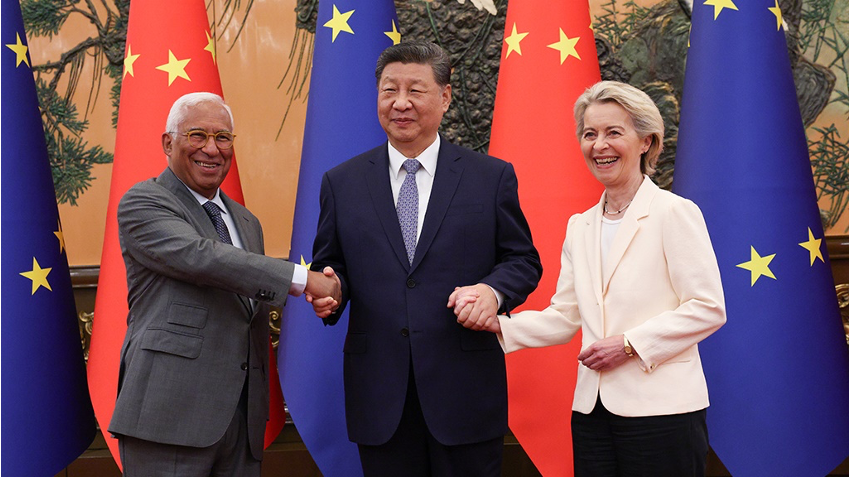
On July 24, 2025, the 25th EU-China Summit took place in Beijing, marking the 50th anniversary of diplomatic relations. European Council President António Costa and European Commission President Ursula von der Leyen met with President Xi Jinping and Premier Li Qiang to discuss their bilateral ties and global challenges.
In a complicated geopolitical context, both sides stressed the need for dialogue and stability. The EU reaffirmed its support for Ukraine and urged constructive global efforts toward peace.
Regarding trade, the EU raised concerns over its €305 billion trade deficit with China, highlighting issues such as industrial overcapacity and market access issues, including in priority sectors such as meat, cosmetics and pharmaceuticals. While open to negotiated solutions, the EU underscored its willingness to act in line with WTO rules when necessary.
Despite tensions, both sides reaffirmed their climate commitments, announcing progress on emissions trading, circular economy cooperation, and biodiversity. A joint statement highlighted their shared ambition ahead of COP30.
The summit also discussed developments in regional policy, financial regulation, and protection of geographical indications, with plans to increase from 200 to 550 recognised products.
Reflecting on 50 years of cooperation, both sides acknowledged existing differences but committed to building a balanced, respectful, and forward-looking partnership in a multipolar world.